
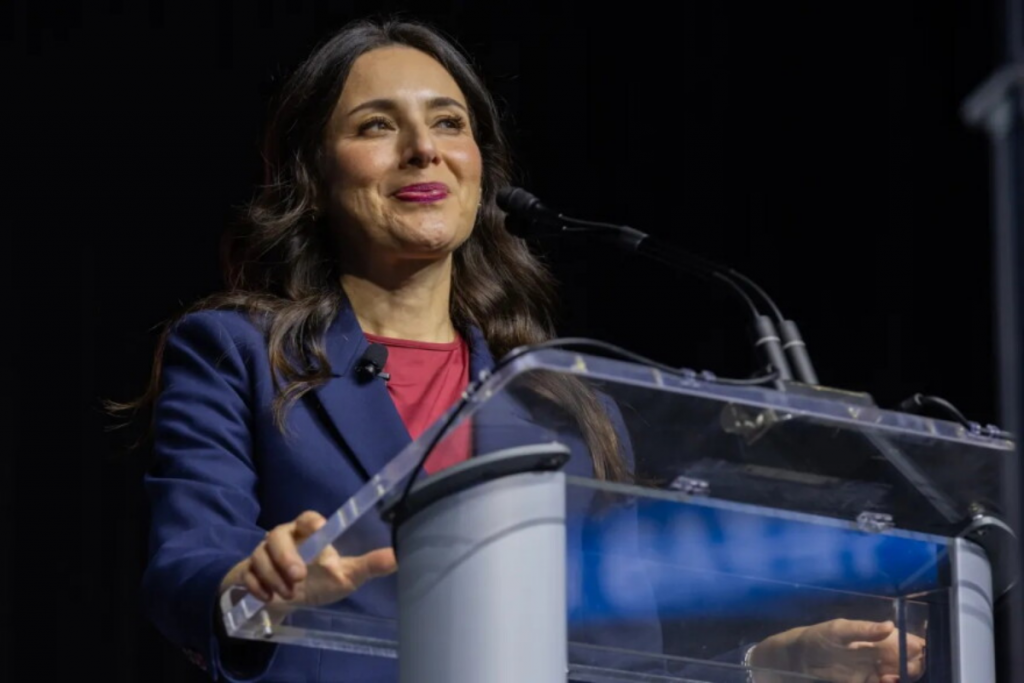
The Democratic nominee for governor says she never voted to raise taxes. Her House votes on the state’s tax caps, the death tax, and the income tax point the other way.
Property taxes are once again the main pocketbook issue in the race for Texas governor. In September, Gov. Greg Abbott’s campaign said his Democratic opponent, State Rep. Gina Hinojosa of Austin, had cast 40 House votes that would raise Texans’ property taxes. Hinojosa’s campaign denies the claim. The record behind that number is worth a close look, especially for Tarrant County residents, who under Judge Tim O’Hare, have seen their county property taxes go down each year of his judgeship.
The 40 Votes in Question
The Legislature doesn’t set your city, county or school tax rate. What it does set are the limits on how fast local governments can grow property tax revenue before voters get the final say. Nearly every vote in the Abbott campaign’s 40-vote tally, spread from 2017 to 2025, concerns those limits. The official House Journal confirms how Hinojosa voted on each one.
The 3.5% cap: In 2019, Senate Bill 2 lowered the growth rate that cities and counties can exceed without an election from 8% a year to 3.5%. Hinojosa voted against it three times, including on the final version that became law (88-50). She also co-authored an amendment that would have let school districts keep using the old 8% trigger under certain conditions.
Keeping 8%: In a 2017 special session, when a Republican colleague moved to lower the trigger to 4%, Hinojosa offered her own amendment to keep it at 8%. The House tabled her amendment 95-45.
Closing loopholes: She voted against a 2021 bill that stopped local governments from using debt issued without voter approval to get around the cap. In 2025, she voted against three more bills: one narrowing a “disaster exception” used to raise taxes without an election, one limiting local debt tax rates, and one stopping school districts from adopting a tax increase again after voters had turned it down.
More relief: In April 2025, she was one of 48 House members who voted against telling budget negotiators to look for an additional $4 billion in property tax relief.
Taken together, these votes would have let property taxes rise faster and kept the door open to higher bills.
Hinojosa disputes the characterization. “I have never, not once, voted to increase property taxes,” she said in response. You can find each of her votes against easing property taxes at the end of this article.
Beyond property taxes
Several of Hinojosa’s other tax votes came on constitutional amendments banning entire categories of taxes. She voted against all of them, and voters approved every one.
The death tax: In 2025, the House voted 112-29 for House Joint Resolution 2, a constitutional ban on estate and inheritance taxes. All 87 Republicans voting and 25 Democrats supported it. Hinojosa voted no. Texas voters approved the ban that November as Proposition 8, with 72.22% voting yes.
The income tax: In a 2016 interview clip that the Abbott campaign posted in September, Hinojosa said Texas relies “too heavily” on property taxes because “we don’t have… the third leg… of that stool that’s required to have a robust and strong and resilient economy, which would include income taxes.”
Her vote matched. On May 9, 2019, the House voted 100-42 for House Joint Resolution 38, a constitutional amendment banning a state personal income tax. Hinojosa voted no. On Nov. 5, 2019, Texans approved the ban as Proposition 4, 74.35% to 25.65%.
Other taxes:
- Wealth tax: voted against House Joint Resolution 132, a constitutional ban on taxing a person’s net worth. It passed the House 101-45 on May 2, 2023, and voters approved it that November as Proposition 3, with 67.89% voting yes.
- Business franchise tax: twice voted against House Bill 28 in 2017, which would have used surplus revenue to phase out and repeal the state’s franchise tax on businesses. It passed 98-45 on April 27 and 96-39 on April 28. The bill later died in the Senate.
- Payroll tax: co-authored House Bill 2604 in 2023, which would have created a paid family leave program funded by a 0.15% charge on employer wages. It died in committee.
Tarrant County shows what local governments can do when their leaders choose restraint.
Before County Judge Tim O’Hare took office in January 2023, the county’s tax rate was 22.4 cents per $100 of value. Since then, the Commissioners Court has cut the rate four years in a row. Each time it adopted a rate below the “no-new-revenue” rate, the rate that would bring in the same revenue from the same properties as the year before.
- 2023: cut 13.17%, to 19.45 cents. The county also adopted its first-ever homestead exemption, at 10%.
- 2024: commissioners voted unanimously in June to double the homestead exemption to 20%, the maximum state law allows. In September, they lowered the rate to 18.75 cents, which the county projected would raise $21.4 million less in property taxes than the year before.
- 2025: 18.62 cents.
- 2026: 18.6 cents, adopted Sept. 15.
All told, the county rate is about 17% lower than when O’Hare took office.
“By increasing the Homestead Exemptions to the maximum allowed by state law, we are ensuring that homeowners will keep more of their hard-earned money,” O’Hare said in 2024. Announcing this year’s budget, he said: “Four years ago, we made a promise to the taxpayers of Tarrant County that we would stop treating their money as ours to spend. This budget is the fourth consecutive year we have kept that promise.”
The state caps set the ceiling. Local leaders decide how far below it to stay. Tarrant County has shown that a large, growing county can cut its rate and still fund law enforcement raises. Over nearly a decade in the House, Hinojosa repeatedly voted against the limits that keep less frugal local governments in check, and she once argued the state was missing an income tax. Tarrant voters weighing who should lead Texas on taxes can compare the two records.
Election Day is Tuesday, November 3rd.
The full list
| All 40 votes in the Abbott campaign’s tally, as recorded in the Texas House Journal 2017: House Bill 486 (an alternative way for certain school districts to calculate their tax-rate limit; a majority of Republicans also voted yes, and the bill died in the Senate) 1. Voted to set aside an amendment requiring voter approval before a school district could use the bill’s alternative calculation. Tabled 101-34, May 2, 2017. 2. Voted YES on the bill at second reading. Passed 90-49, May 2, 2017. 3. Voted YES on final passage. Passed 104-40, May 3, 2017. 2017 special session: Senate Bill 1 (would have cut the no-election trigger for local tax increases from 8% to 6%; never enacted) 4. Voted to keep alive her own amendment to keep the trigger at 8% instead of the proposed 4%. Tabled 95-45, Aug. 12, 2017. 5. Voted to set aside an amendment that would have lowered the trigger from 6% to 4%. Tabled 80-52, Aug. 12, 2017. 6. Voted YES to add hospital districts to the list of local governments exempt from the bill. Failed 54-86, Aug. 12, 2017. 7. Voted YES to let school districts use a 6.77% trigger in 2018 and 2019. Failed 46-92, Aug. 12, 2017. 8. Voted YES to exempt local governments that spend at least 60% of their budgets on public safety. Failed 48-91, Aug. 12, 2017. 9. Voted YES to adjust the limit upward for transportation costs. Adopted 71-63, Aug. 12, 2017; later reconsidered. 10. Voted YES to adjust the limit upward for indigent mental health costs. Failed 44-92, Aug. 12, 2017. 11. Voted YES to make the bill take effect only if the state funded at least half of school costs. Failed 47-93, Aug. 12, 2017. 12. Voted YES to adjust the limit upward for public safety crisis costs. Failed 46-94, Aug. 12, 2017. 13. Voted YES on an amendment adding a school-funding provision involving the state’s Rainy Day Fund. Failed 46-94, Aug. 12, 2017. 14. Voted NO on the bill at second reading. Passed 98-43, Aug. 12, 2017. 15. Voted NO on final passage. Passed 105-41, Aug. 14, 2017. 2019: Senate Bill 2 (the 3.5% voter-approval cap for cities and counties; became law) 16. Voted to keep alive an amendment that would have let some emergency services districts avoid the 3.5% cap. Tabled 84-59, April 30, 2019. 17. Voted to keep alive an amendment that would have raised the cap from 3.5% to 3.51%. Tabled 84-62, April 30, 2019. 18. Voted to keep alive an amendment she co-authored that would have let school districts use 8% instead of 3.5% if the state’s share of school funding fell. Tabled 85-62, April 30, 2019. 19. Voted to keep alive an amendment that would have allowed an add-on tax rate of up to 1 cent, with voter approval, for dedicated purposes. Tabled 84-63, April 30, 2019. 20. Voted to keep alive an amendment that would have adjusted the cap upward for public safety spending. Tabled 80-65, April 30, 2019. 21. Voted to keep alive an amendment that would have adjusted the cap upward for public safety pension costs. Tabled 81-63, April 30, 2019. 22. Voted to keep alive an amendment that would have adjusted the cap upward for state transportation project costs. Tabled 83-57, April 30, 2019. 23. Voted to keep alive an amendment that would have adjusted the cap upward for economic development spending. Tabled 85-61, April 30, 2019. 24. Voted NO on the bill at second reading. Passed 107-40, April 30, 2019. 25. Voted NO on final House passage. Passed 109-36, May 1, 2019. 26. Voted NO on the final version that became law. Adopted 88-50, May 25, 2019. 2021: House Bill 1869 (stopped cities and counties from using non-voter-approved debt, such as certificates of obligation, to get around the cap; became law) 27. Voted YES to limit the bill to counties with 1.9 million to 4 million residents. Failed 71-68 (two-thirds required), May 5, 2021. 28. Voted YES to create a special debt definition for counties of 1.8 million or more and large cities. Failed 70-71, May 5, 2021. 29. Voted NO on the final version. Adopted 72-67, May 30, 2021. 2021 special session: Senate Bill 1 (property tax relief) 30. Voted NO on the House version. Passed 140-4, Oct. 15, 2021. (She voted for the final version, 146-0, on Oct. 18.) 2025 regular session 31. State budget (Senate Bill 1): Voted NO on instructing House budget negotiators to seek an additional $4 billion in property tax relief. Prevailed 97-48, April 15, 2025. 32. House Bill 30 (narrowing the “disaster exception” used to exceed the cap without an election): Voted NO at second reading. Passed 83-55, May 7, 2025. 33. House Bill 30: Voted NO on final passage. Passed 95-51, May 8, 2025. 34. Senate Bill 1502 (barring a school district from adopting a tax increase again after voters reject it): Voted NO. Passed 102-27, May 10, 2025. 35. Senate Bill 1453 (limiting the debt portion of a tax rate to what is needed for required debt payments): Voted NO at second reading. Passed 102-35, May 23, 2025. 36. Senate Bill 1453: Voted NO on final passage. Passed 101-32, May 24, 2025. 2025 special session: Senate Bill 10 (tightening the no-election revenue cap for cities and counties) 37. Voted NO on an amendment cutting the cap from 2.5% to 1%, with a public safety adjustment. Adopted 94-43, Aug. 25, 2025. 38. Voted NO on the bill at second reading. Passed 81-55, Aug. 25, 2025. 39. Voted NO on final House passage. Passed 78-52, Aug. 25, 2025. 40. Voted NO on the final compromise version. Failed 60-71, Sept. 2, 2025. |