
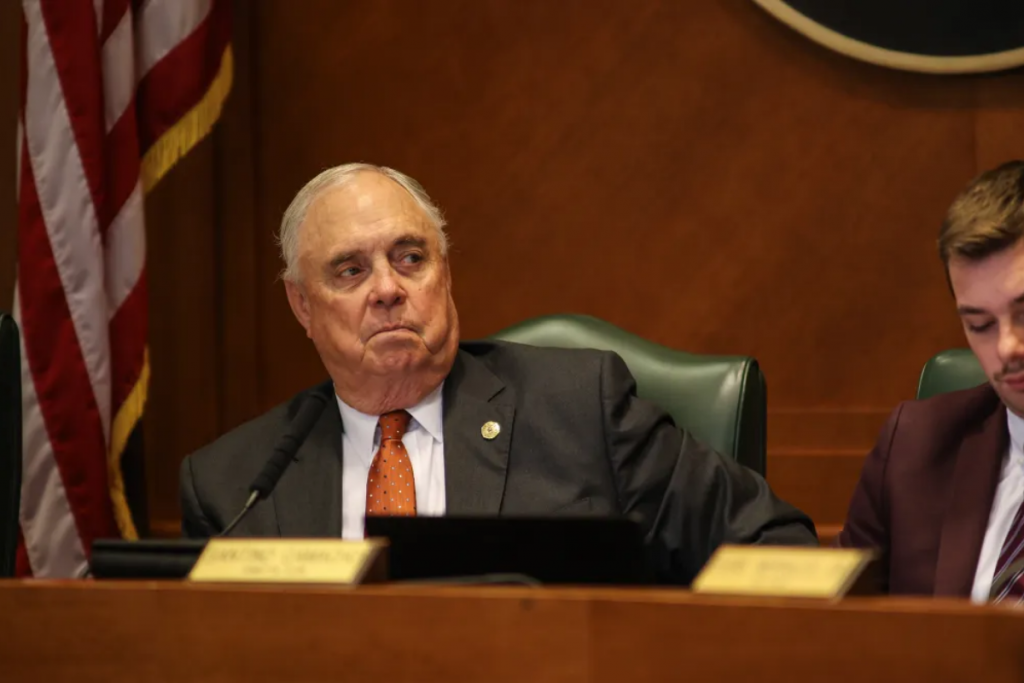
A dispute between Texas House Energy Resources Chairman Drew Darby and Railroad Commissioner Wayne Christian escalated Tuesday after Darby sharply criticized Christian for missing a legislative oversight hearing and suggested lawmakers could reconsider the future of the elected commission.
Darby, R-San Angelo, opened the hearing Tuesday by accusing Christian of deliberately defying the committee and suggested lawmakers would revisit the Railroad Commission’s authority during the 2027 legislative session. “I do not recall my request for his presence as being optional,” Darby said, accusing Christian of making a “mockery” of the legislative oversight process. Darby went so far as to remind those attending that the Legislature created the Railroad Commission and could abolish it by majority vote.
Christian fired back after the hearing, calling Darby’s criticism an “attack on democracy” and arguing that the chairman’s response to a procedural dispute threatened Texans’ ability to choose their Railroad Commissioners at the ballot box.
Christian disputed the suggestion that he simply refused to appear. Christian instead submitted written testimony to the committee explaining both his absence and the commission’s recent changes to its public-participation policy.
The dispute began after the Railroad Commission changed a decades-old policy that automatically placed a general public-comment period on every commission meeting agenda. Critics, including Darby, have portrayed the change as limiting Texans’ ability to address their elected commissioners.
Christian argues that characterization leaves out significant portions of the new policy. Texans can still register to speak about specific matters before the commission, and an individual commissioner can request that a general public-comment item be placed on a meeting agenda. The commission’s Office of Public Engagement is also required to hold at least 12 listening sessions annually, which Texans can join in person, virtually or by telephone.
“Public input at the RRC has not been canceled, banned, restricted or censored,” Christian said when the policy was announced in August.
Christian has argued that the new system more closely resembles the Texas Legislature itself, where committees do not provide an unrestricted general-comment period at every meeting. He said broader listening sessions could also make participation easier for Texans who would otherwise have to travel hundreds of miles to Austin to speak for several minutes before the commission.
Railroad Commission records cited by Christian also show relatively limited use of the previous system. According to the commission, 102 general public-comment registrations were filed at 37 open meetings beginning in 2022, representing about 20 individuals. The commission said nearly 65% of the registrations came from just two people.
In his letter Tuesday, Christian also raised concerns about the political context surrounding the hearing because Democratic state Rep. Jon Rosenthal, a member of Darby’s committee, is currently the Democratic nominee for Railroad Commissioner.
“The Committee risks transforming a taxpayer-funded legislative hearing into a political platform that unfairly impacts an election over a dispute involving a procedural policy implemented by three democratically elected statewide officials,” Christian wrote.
The dispute partially overshadowed a broader policy issue before the Energy Resources Committee: Texas’ large inventory of inactive oil and gas wells.
The Railroad Commission oversees nearly 160,000 inactive wells, while at least 12,000 wells are classified as orphaned, meaning their responsible operators can no longer be relied upon to plug them. Lawmakers have ordered the commission to update its rules governing inactive wells, which can pose environmental and financial risks if they are abandoned.